Reclaiming Creativity from the Monopoly of Scale
- jeremia92
- Nov 12, 2025
- 3 min read
November 10, 2025
Sometimes I wonder if what we are witnessing is not a global drought of imagination, but a systematic narrowing of its corridors. Walk into any major corporate campus or browse the top trending digital platforms, and a troubling uniformity emerges. Everything begins to look the same, not for a lack of new ideas, but because the ideas that achieve mainstream visibility are disproportionately those backed by capital, not conviction.
We have reached an inflection point where creativity, once the freest expression of the human spirit, has become subordinate to the same hierarchies of scale that govern financial markets. The most visible ideas are not always the most valuable; they are merely the most resourced. The result is a strange, persistent illusion of progress: endless cycles of innovation that deliver little more than recurring sameness.
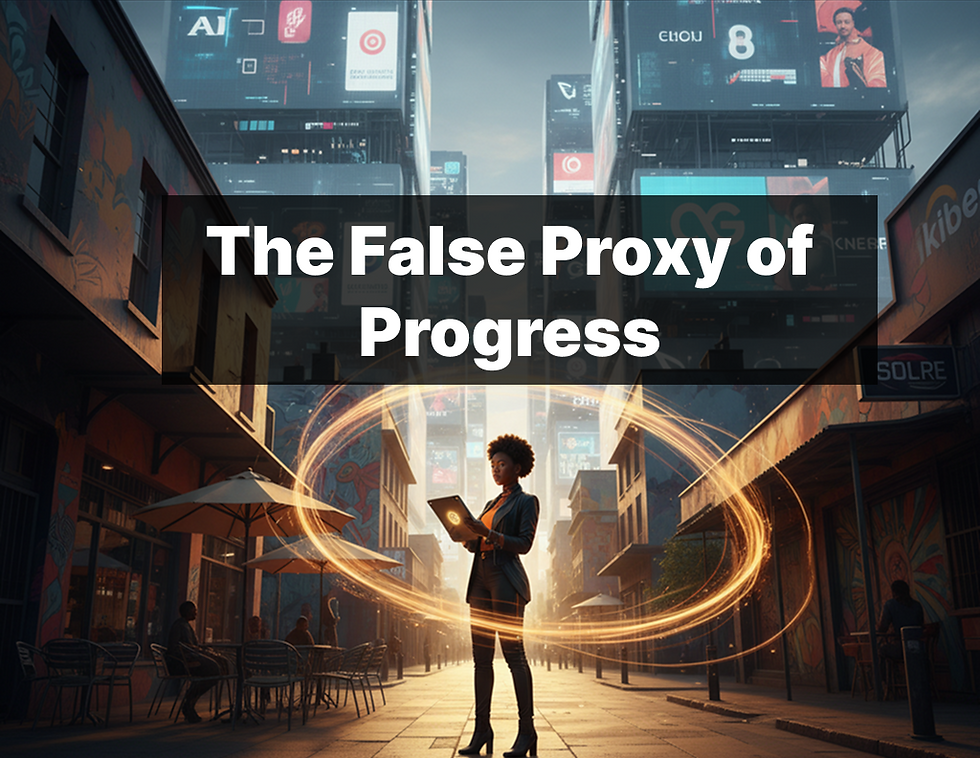
The False Proxy of Progress
The original purpose of creativity was to serve life itself, to help us see differently, live better, and connect more deeply. Yet, today, even the most transformative ideas must first apply for funding before they are permitted to breathe. The currency of visibility has aggressively supplanted the value of originality.
This dynamic creates a profound market distortion. A single entity can now monopolise a category of thought or an infrastructural layer so completely that other imaginations are forced to orbit around it. They are constrained not by a lack of merit, but by a critical infrastructure deficit. A competing, more socially beneficial argument may fail to gain traction, not because it is senseless, but because it is a weakly capitalised argument.
In a world that claims to long for genuine innovation, particularly across the digital and societal landscapes, the answer is not simply more concentrated capital, whether intellectual or financial. We have grown comfortable speaking of "market share" because it signals the right intent, yet we are no longer surprised when we find the same logos, the same legacy consulting firms, and the same corporate structures dominating the floors of government and major institutions. When we see the resulting products and campaigns, we see the same "innovation," predictably replicated and endlessly rebranded.

The Erosion of Creative Equity
Consider the talented artist whose work moves continents and anchors multi-year campaigns, whose creativity has profoundly shaped public perception. Yet, their relevance and staying power remain confined to the finite lifespan of a single engagement. How does brilliance become disposable?
It happens because their intrinsic value, like that of countless others, is only recognised once it is filtered through a larger brand, through Company X. The infrastructure to deliver at scale belongs to X. The brand equity, reinforced by the creative work, belongs to X. And so the artist, though the origin of beauty and meaning, remains peripheral to the power their creativity sustains. Their genius is rented, not owned.
This is the strategic flaw in our current model. We must be innovative not only at the product level, but also as socially and economically conscious drivers of progress, reimagining how we distribute market share in the creative pursuit, in intellectual property, and in financial opportunity.

A Philosophical and Economic Reckoning
This brings us to the central philosophical and economic challenge of our age:
Is creativity still an expression of the human spirit, or has it become a mere line-item on the balance sheet?
If we are to foster true diversity in how solutions are shaped, solutions that impact communities and serve as intellectual drivers of genuine change, then we must transition how we assign currency to creative output. We must deliberately expand access to both economic and social capital for emergent, unconventional, and purpose-driven creators.
As Plato once taught, the unexamined system is unworthy of preservation. It is time to examine not just what we create, but how creation itself is valued. For if we continue to conflate capital with creativity, if we allow a monopoly of scale to dictate the boundaries of the possible, we risk designing a world that may be highly profitable, but one that is profoundly, unforgivably un-beautiful.


Comments